Weaving draft designer
On a shaft loom, each warp end is threaded on one of the shafts, the treadles are tied to lift chosen shafts, and together the threading, tie-up and treadling make the pattern: twills, diamonds, overshot, blocks. A weaving draft writes all of this on a grid: the threading, the tie-up, the treadling, and the drawdown, the cloth they make. Chromattice redraws the drawdown as you change the other three.
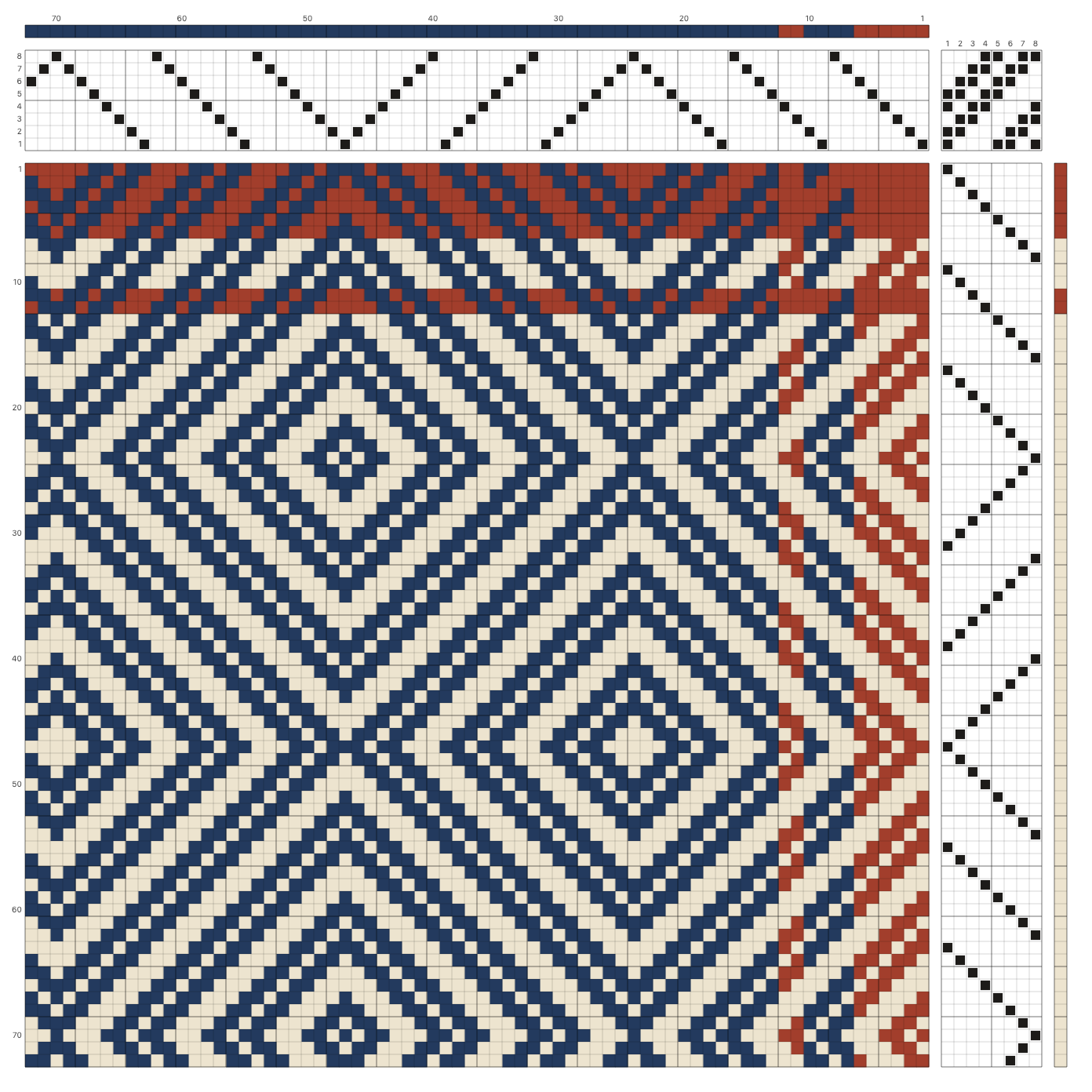 An example made in Chromattice
What the designer does for weaving
- All four parts of the draft, live: tap to change the threading, tie-up or treadling and the drawdown redraws at once, in colour, black and white, as threads crossing, or from the back.
- Threadings written the way weavers write them: type a sequence such as 3(1..8) 7..1 and how many repeats; straight, point, rosepath and advancing units are built in.
- Twill and plain-weave tie-ups in a tap, and treadling “as drawn in” that follows the threading.
- Warp and weft colour orders typed as counts, with the ends and picks of each colour counted.
- Checked before you warp: floats longer than your limits, ends on no shaft and picks that lift nothing are flagged, and the sett gives the cloth its true size.
- A print for the loom, with the threading in repeats, heddles per shaft, the tie-up and the treadling in runs, and WIF files to open the draft in other weaving programs.
Good to know
- In the common American layout, the threading’s bottom row is shaft one, the shaft nearest you, and it’s read from right to left; the treadling is read from the top down, a row a pick. Swedish drafts are laid out differently. (gistyarn.com)
- The drawdown pictures what the threading, tie-up and treadling make between them: you don’t usually need it to weave, but it lets you try colours and treadlings before you start. (handwovenmagazine.com)
- Twills want a closer sett than plain weave, since the weft passes over more than one end at a time and the threads draw together: a yarn at 12 ends an inch in plain weave might want 15 in twill. Weave and wash a sample first. (schachtspindle.com)
- A point twill runs one way and then turns back (1-2-3-4-3-2); an extended point twill combines straight runs with points, and threadings like bird’s eye make diamonds. (schachtspindle.com)
- WIF (Weaving Information File) is a plain-text format made so drafts can be shared between weaving programs. (nationalarchives.gov.uk)
Other crafts
Chromattice needs JavaScript for the designer.